

What are Environmentally Acceptable Lubricants (EAL)?
Environmentally Acceptable Lubricants (EAL) refers to the following lubricants, different base oil types and product categories.
Different Base Oil Types & Product Categories
- HETG(Environmentally friendly triglyceride oil-based hydraulic oil)
- HEPG (Environmentally friendly polyethylene glycol-based hydraulic oil)
- HEES (environmentally friendly synthetic ester-based hydraulic fluids)
- HEPR (PAO and other chemical synthetic hydrocarbon based hydraulic fluids) as a fourth group
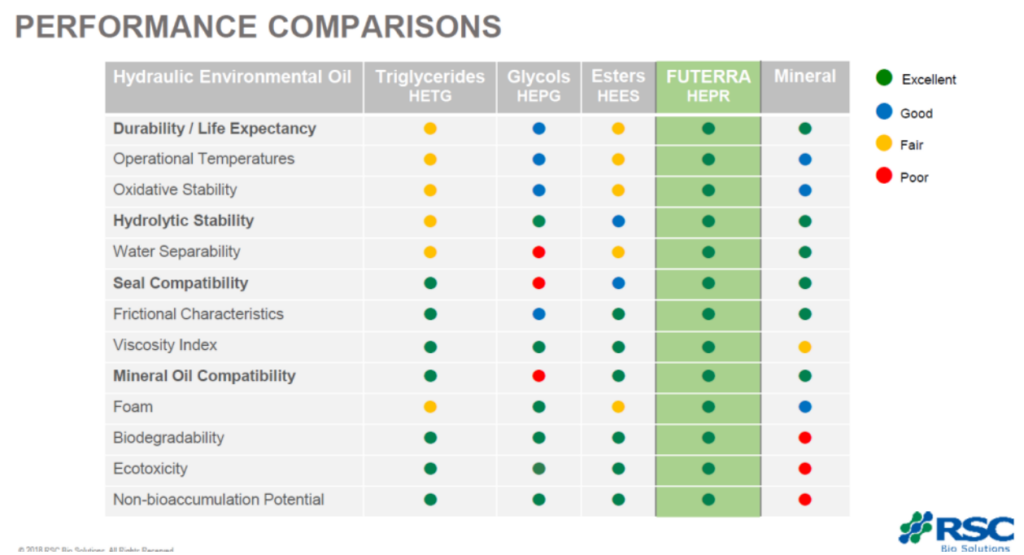
4 HEPR (PAO and Other Chemical Synthetic Hydrocarbon) Hydraulic Oil
Chemically produced PAO has the following characteristics compared to mineral oil, and its properties are shown in Table 1.
Table 1 shows the properties of chemically produced PAO.
(1) High viscosity index, which enables the retention of a thick oil film even at high temperatures.
(2) Because it does not contain wax, it has an extremely low flow point and good low-temperature viscosity characteristics, making it suitable for low-temperature starting and warming of internal combustion engines, etc.
(2) Since it does not contain wax, it has a very low flow point and good low-temperature viscosity characteristics, which enables low-temperature starting of internal combustion engines and shortened warm-up time.
(3) Highly effective addition of additives, good thermal oxidation stability, use at high temperatures, and longer service life.
is possible
(4) Low traction coefficient and energy saving are possible.
Figure 1: Synthesis of PAO (R: alkyl group)
(5) Little effect on metal corrosion and plastics
(6) Narrow molecular weight distribution and low evaporation loss at high temperatures
CO2 Emission Reduction
The use of saturated synthetic ester lubricants has drastically reduced the frequency of oil changes, thereby contributing greatly to the reduction of CO2 emissions through waste oil disposal.